

Which Digital Camera Has The Largest Sensor

Crews at the Department of Energy'southward SLAC National Accelerator Laboratory accept taken the first 3,200-megapixel digital photos—the largest ever taken in a single shot—with an extraordinary array of imaging sensors that volition get the heart and soul of the time to come camera of Vera C. Rubin Observatory.
The images are so large that it would accept 378 4K ultra-high-definition TV screens to display one of them in full size, and their resolution is and so high that you could see a golf ball from near 15 miles away. These and other properties will presently drive unprecedented astrophysical enquiry.
Next, the sensor assortment volition be integrated into the world's largest digital camera, currently under construction at SLAC. Once installed at Rubin Observatory in Chile, the camera volition produce panoramic images of the complete Southern heaven—one panorama every few nights for 10 years. Its data will feed into the Rubin Observatory Legacy Survey of Infinite and Time (LSST)—a catalog of more galaxies than there are living people on Earth and of the motions of countless astrophysical objects. Using the LSST Photographic camera, the observatory will create the largest astronomical moving picture of all fourth dimension and shed light on some of the biggest mysteries of the universe, including dark matter and dark energy.
The commencement images taken with the sensors were a examination for the photographic camera's focal plane, whose assembly was completed at SLAC in January.
"This is a huge milestone for us," said Vincent Riot, LSST Camera project director from DOE's Lawrence Livermore National Laboratory. "The focal plane will produce the images for the LSST, and so it's the capable and sensitive eye of the Rubin Observatory."
SLAC's Steven Kahn, director of the observatory, said, "This achievement is among the about significant of the unabridged Rubin Observatory Project. The completion of the LSST Photographic camera focal plane and its successful tests is a huge victory by the camera team that will enable Rubin Observatory to deliver next-generation astronomical science."
A technological curiosity for the best science
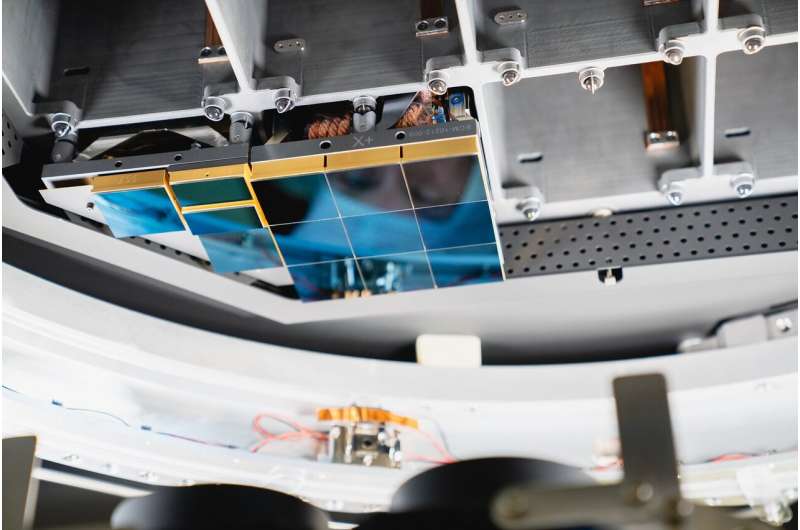
In a manner, the focal plane is similar to the imaging sensor of a digital consumer camera or the camera in a jail cell telephone: It captures light emitted from or reflected by an object and converts it into electric signals that are used to produce a digital prototype. Only the LSST Photographic camera focal plane is much more than sophisticated. In fact, information technology contains 189 individual sensors, or charge-coupled devices (CCDs), that each bring 16 megapixels to the tabular array—about the same number as the imaging sensors of most modern digital cameras.
Sets of nine CCDs and their supporting electronics were assembled into square units, called "science rafts," at DOE's Brookhaven National Laboratory and shipped to SLAC. There, the photographic camera squad inserted 21 of them, plus an additional 4 specialty rafts non used for imaging, into a grid that holds them in place.
The focal plane has some truly boggling properties. Non only does it contain a whopping 3.2 billion pixels, but its pixels are also very small—about 10 microns wide—and the focal plane itself is extremely apartment, varying by no more than a tenth of the width of a human pilus. This allows the camera to produce sharp images in very loftier resolution. At more than 2 feet wide, the focal aeroplane is enormous compared to the one.4-inch-wide imaging sensor of a full-frame consumer photographic camera and large enough to capture a portion of the sky about the size of 40 full moons. Finally, the whole telescope is designed in such a manner that the imaging sensors will be able to spot objects 100 million times dimmer than those visible to the naked eye—a sensitivity that would let you see a candle from thousands of miles abroad.
"These specifications are just astounding," said Steven Ritz, project scientist for the LSST Photographic camera at the University of California, Santa Cruz. "These unique features will enable the Rubin Observatory'southward ambitious science plan."
Over 10 years, the camera volition collect images of about 20 billion galaxies. "These data will ameliorate our noesis of how galaxies have evolved over time and will let us exam our models of dark matter and dark energy more securely and precisely than ever," Ritz said. "The observatory will exist a wonderful facility for a wide range of science—from detailed studies of our solar system to studies of faraway objects toward the border of the visible universe."
A high-stakes assembly procedure
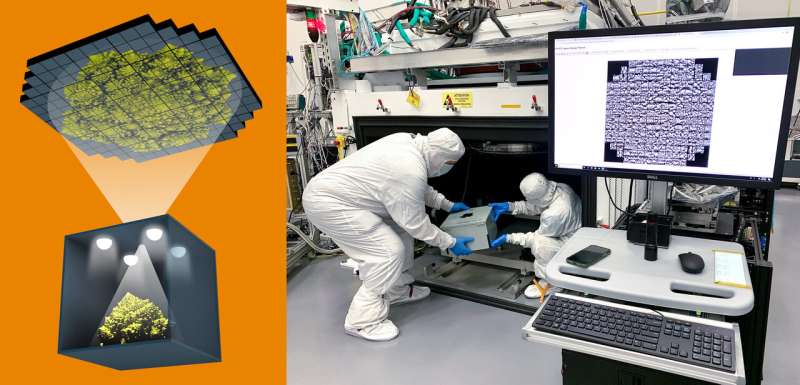
The completion of the focal plane before this year concluded vi nerve-wracking months for the SLAC crew that inserted the 25 rafts into their narrow slots in the filigree. To maximize the imaging area, the gaps between sensors on neighboring rafts are less than 5 human hairs wide. Since the imaging sensors hands crack if they touch each other, this fabricated the whole operation very tricky.
The rafts are also costly—up to $3 million apiece.
SLAC mechanical engineer Hannah Pollek, who worked at the front line of sensor integration, said, "The combination of high stakes and tight tolerances made this projection very challenging. But with a versatile squad we pretty much nailed information technology."
The team members spent a year preparing for the raft installation by installing numerous "practice" rafts that did not go into the final focal plane. That allowed them to perfect the procedure of pulling each of the two-foot-tall, 20-pound rafts into the filigree using a specialized gantry developed by SLAC's Travis Lange, lead mechanical engineer on the raft installation.
Tim Bail, head of the LSST Camera Integration and Examination team at SLAC, said, "The sheer size of the individual photographic camera components is impressive, and and then are the sizes of the teams working on them. Information technology took a well-choreographed team to complete the focal plane assembly, and admittedly everyone working on it rose to the challenge."
Taking the showtime 3,200-megapixel images
The focal plane has been placed within a cryostat, where the sensors are cooled down to negative 150 degrees Fahrenheit, their required operating temperature. After several months without lab admission due to the coronavirus pandemic, the photographic camera squad resumed its work in May with limited capacity and post-obit strict social distancing requirements. Extensive tests are now underway to make sure the focal airplane meets the technical requirements needed to support Rubin Observatory's science programme.
Taking the first 3,200-megapixel images of a variety of objects, including a Romanesco that was chosen for its very detailed surface structure, was ane of these tests. To do so without a fully assembled camera, the SLAC team used a 150-micron pinhole to projection images onto the focal airplane. These photos, which can be explored in full resolution online (links at the bottom of the release), show the boggling detail captured by the imaging sensors.
"Taking these images is a major accomplishment," said SLAC's Aaron Roodman, the scientist responsible for the associates and testing of the LSST Photographic camera. "With the tight specifications nosotros actually pushed the limits of what's possible to have advantage of every square millimeter of the focal airplane and maximize the science nosotros tin can do with information technology."
Camera team on the domicile stretch
More than challenging work lies ahead as the team completes the camera assembly.
In the next few months, they will insert the cryostat with the focal plane into the camera body and add the camera'southward lenses, including the world's largest optical lens, a shutter and a filter exchange system for studies of the dark heaven in different colors. By mid-2021, the SUV-sized camera will be set for terminal testing before it begins its journey to Republic of chile.
"Nearing completion of the camera is very exciting, and we're proud of playing such a central role in building this cardinal component of Rubin Observatory," said JoAnne Hewett, SLAC's chief research officer and associate lab director for fundamental physics. "Information technology's a milestone that brings us a big step closer to exploring fundamental questions about the universe in means we oasis't been able to before."
Citation: Sensors of world'south largest digital camera snap start iii,200-megapixel images at SLAC (2020, September viii) retrieved 2 June 2022 from https://phys.org/news/2020-09-sensors-world-largest-digital-camera.html
This document is field of study to copyright. Apart from any fair dealing for the purpose of private study or inquiry, no part may be reproduced without the written permission. The content is provided for data purposes simply.
Source: https://phys.org/news/2020-09-sensors-world-largest-digital-camera.html
Posted by: cifuentestheigh1992.blogspot.com
0 Response to "Which Digital Camera Has The Largest Sensor"
Post a Comment